Needs surface too late.
People often ask for help only after a problem becomes visible. Everyday loneliness, financial pressure, family strain, and questions of purpose remain largely invisible.
Kawansela closes a costly institutional blind spot: what people need, how they respond, and whether support made a difference—starting with sponsor-funded physical distribution in Indonesia.
01 · The problem investors can underwrite
Churches, foundations, and community organizations can see attendance, donations, form fills, and program participation. They cannot continuously see what people are carrying, what response is appropriate, or whether support reached the person who needed it.
People often ask for help only after a problem becomes visible. Everyday loneliness, financial pressure, family strain, and questions of purpose remain largely invisible.
Surveys capture a moment. Spreadsheets capture cases. Generic AI captures prompts. None of them creates a continuous, culturally relevant view of community need.
Even when a need is detected, follow-up is distributed across staff, messages, volunteers, counselors, and programs—with no closed loop for accountability.
The institutional blind spot
02 · The solution
Kawansela follows a disciplined sequence: prove distribution through the Cart, activate recurring engagement through Kawansela AI, and launch Institutional SaaS only after the data and workflows are ready.
A sponsor-funded community microbusiness that establishes daily presence and acquires digital users through trusted, ordinary interactions.
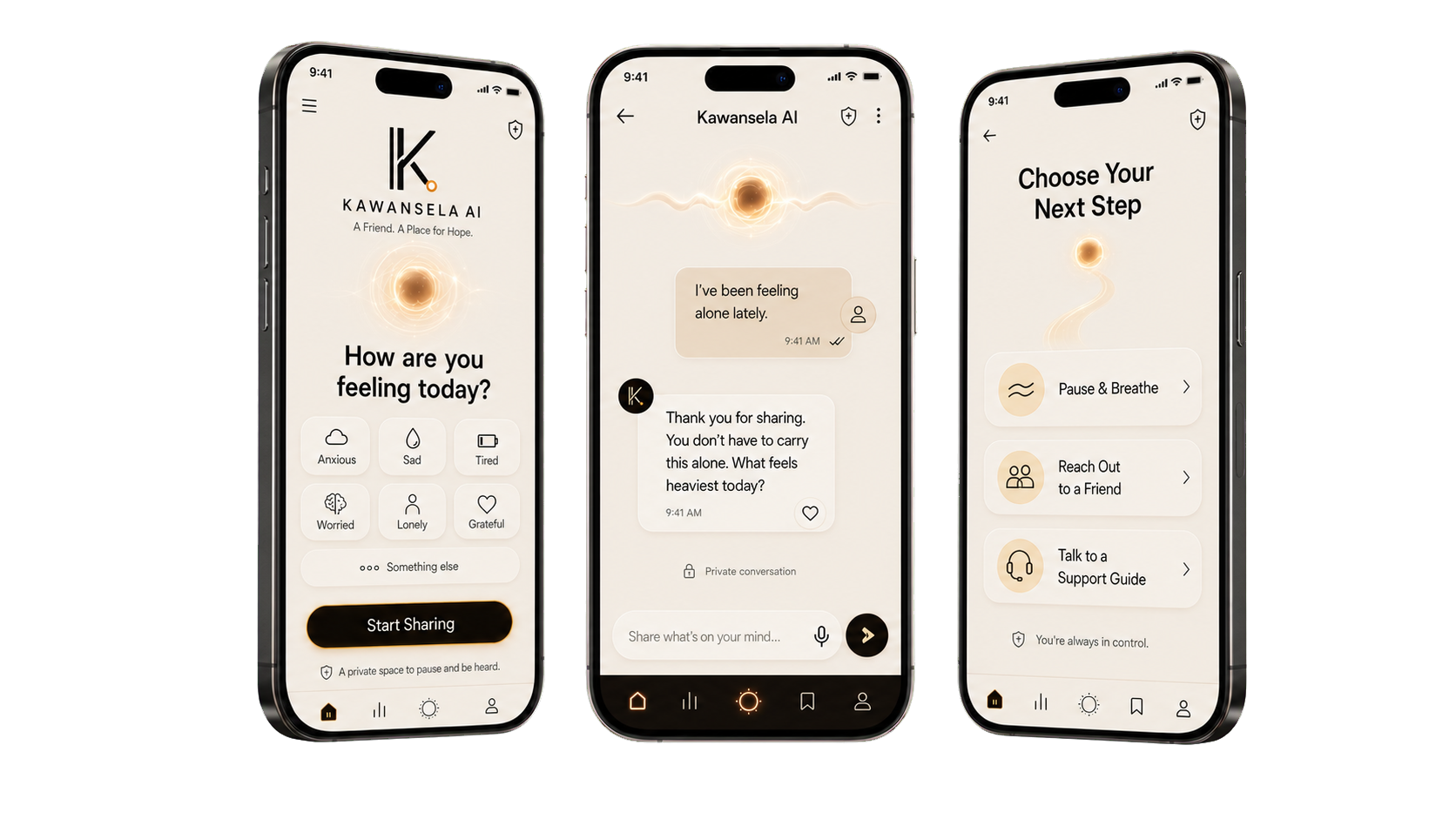
A culturally relevant, relational “AI of Hope” for encouragement, continuing journeys, and movement toward human support.
Backend software to gather community-needs data, understand responses, automate follow-up, coordinate action, and measure outcomes.
What do people need? How are they responding? What should we do next? Did our response make a difference?
Kawansela connects trusted data collection, culturally relevant AI, institutional workflow, and outcome measurement. The product does not end when a conversation ends—it helps authorized institutions understand, respond, and learn what made a difference.
Sponsors pay to establish physical distribution, giving Kawansela a trusted acquisition channel without depending entirely on digital advertising.
Kawansela earns naturally occurring, first-party, permissioned community-needs signals through repeated engagement. It does not sell identifiable personal information.
Kawansela AI is designed for continuing journeys, local context, permission-based memory, and movement toward meaningful human support—not isolated prompt-and-answer sessions.
With consent, need signals can activate institutional workflows, assign follow-up, coordinate action, and measure whether the response made a difference. This creates a defensible learning loop beyond conversation data.
The Cart provides physical distribution. Kawansela AI provides consumer engagement. Institutional SaaS provides scalable, recurring software economics.
03 · Why Indonesia first
Indonesia is not a source of cheap or exploitable data. It is a demanding, mobile-first market where trusted distribution, localization, low-cost delivery, and institutional coordination must all work together.
72.78% of Indonesians accessed the internet in 2024, yet geography, institutional capacity, and service access remain uneven. Kawansela is built for that tension.
Local language, operating relationships, and community networks reduce the distance between product decisions and lived reality.
A system proven across low-bandwidth, multilingual, resource- constrained environments can become a leaner and more adaptable product for higher-capacity U.S. institutions.
Sources: BPS Indonesia and World Bank
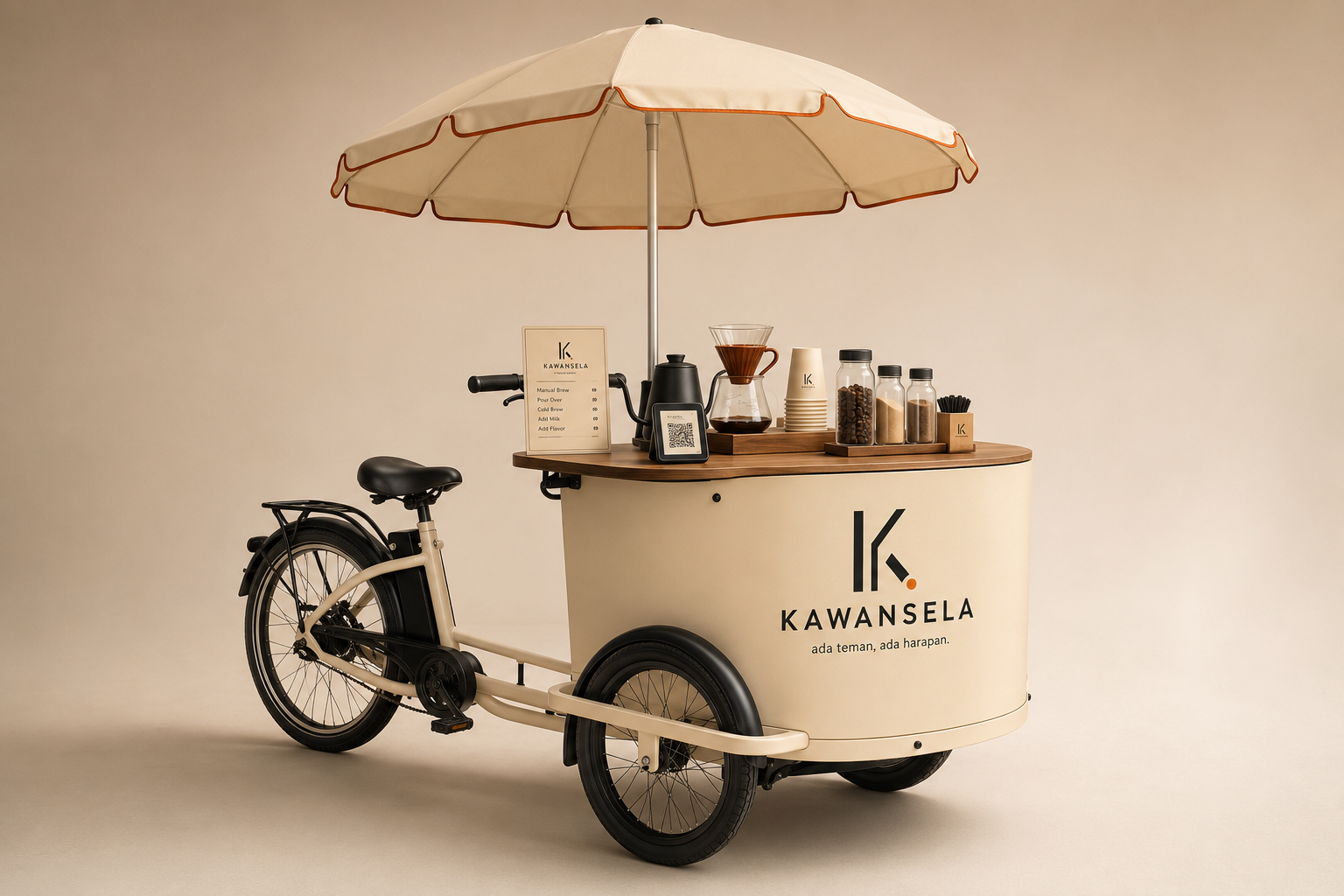
A community microbusiness, a trusted brand presence, and a technology acquisition channel in one deployment.
What transfers is the capability—not identifiable community data.
04 · The business model
Cart deployment revenue funds the initial wedge. Kawansela AI adds recurring engagement revenue. Institutional SaaS becomes the high-margin platform only after Kawansela earns enough permissioned data and operational evidence.
The sponsor, operator, user, beneficiary, and software customer may be different parties. Sponsors finance distribution, local partners retain coffee revenue, people use Kawansela AI, and institutions purchase recurring software.
Cart + implementation + launch
Additional carts + new regions
Seats + locations + enterprise
05 · Market potential
Kawansela’s initial customer profile is not every small church. It is the high-capacity layer: large churches, multisite networks, foundations, universities, ministries, and faith-based nonprofits.
U.S. charitable giving to religion in 2024
Giving USA / Lilly Schoolestimated U.S. religious congregations
Hartford Institutelarger congregations in the initial capacity segment, derived from the largest 13%
78% of attendees sit in this segmentKawansela has relationship access to several religious institutions that collectively oversee at least 1,000,000 members worldwide. This creates a high-leverage pathway for AI distribution, SaaS design partnerships, and future multi-location pilots.
Relationship access—not contracted users or booked revenue.These companies validate separate pieces of Kawansela’s thesis: institutional adoption, consumer subscription, and venture appetite for purpose-aligned technology.
Validates specialized software for a broad faith and flourishing ecosystem of churches, nonprofits, and mission-driven organizations.
View sourceValidates willingness to pay for premium faith-aligned digital experiences; reported 10M downloads and $105M raised in 2023.
View sourceValidates consumer scale and a diversified model where subscription is primary, supported by additional monetization.
View source06 · How the three revenue engines work together
Kawansela converts sponsor-funded physical distribution into consumer engagement, permissioned intelligence, institutional action, and ultimately subscription expansion.
A U.S. foundation, philanthropist, or religious institution purchases a Kawansela Cart deployment, creating upfront revenue capped at $5,000 per cart.
The local institution retains all coffee revenue while the cart creates employment, trusted community presence, and daily interaction.
Community members encounter Kawansela through an ordinary, trusted touchpoint and enter the digital experience.
People return for encouragement, personal journeys, and support navigation through free, premium, or institution-sponsored access.
With appropriate consent—and after Kawansela reaches a sufficient data threshold—community-needs signals can enter Institutional SaaS.
The SaaS organizes needs, automates follow-up, assigns ownership, coordinates action, and measures outcomes.
Institutions renew and expand subscriptions across additional teams, locations, and networks—funding the next cycle of growth.
Sponsored deployment revenuefinances physical distribution.
Kawansela AI revenuemonetizes consumer engagement.
Institutional SaaS revenuemonetizes institutional intelligence and action.
07 · The capital architecture
Kawansela does not ask investors to permanently subsidize donated carts—and does not ask philanthropy to fund unrelated corporate overhead.
Carts, local implementation, training, beneficiary access, project-specific technology, and measurable field outcomes.
Cart technology, Kawansela AI, permissioned-data infrastructure, safety, and the later Institutional SaaS platform.
Premium and sponsored AI access, Institutional SaaS subscriptions, enterprise licenses, support renewals, and expansion contracts.
08 · The round
Capital to convert a validated problem, differentiated distribution thesis, and active philanthropic pipeline into a working platform with measurable software economics.
Cart acquisition stack, Kawansela AI MVP, and the foundational institutional data layer
Consent, security, localization, analytics, and reliability
User activation, retention, response, and unit-economics tests
Foundation, church-network, and enterprise partnerships
Entity, data, IP, finance, and cross-border foundations
Deploy the first Kawansela Cart network and operating system
Launch Kawansela AI through trusted cart communities
Measure cart-to-AI activation and 30/90-day retention
Reach a permissioned-data threshold and secure design partners
Prepare the first Institutional SaaS pilot for validated demand
09 · Built across both sides of the bridge
Indonesian founder connecting community implementation, Business-as-Mission experience, and U.S. philanthropic networks.
Carnegie Mellon graduate and former Microsoft technologist leading systems, product, and execution.
Former White Rhino Coffee CEO bringing scaled F&B operations, foundation, and organizational experience.
Sovereign Capital perspective across faith-driven enterprise and Asia-focused investment networks.
President & CEO of Philanthropy Southwest and a United Philanthropy Forum board member, bringing national philanthropic networks and grantmaker-sector leadership.
Pastor, Republican Party of Texas State Chaplain, and Republican nominee for Texas State Board of Education District 9—bringing faith-community relationships and institutional insight.